

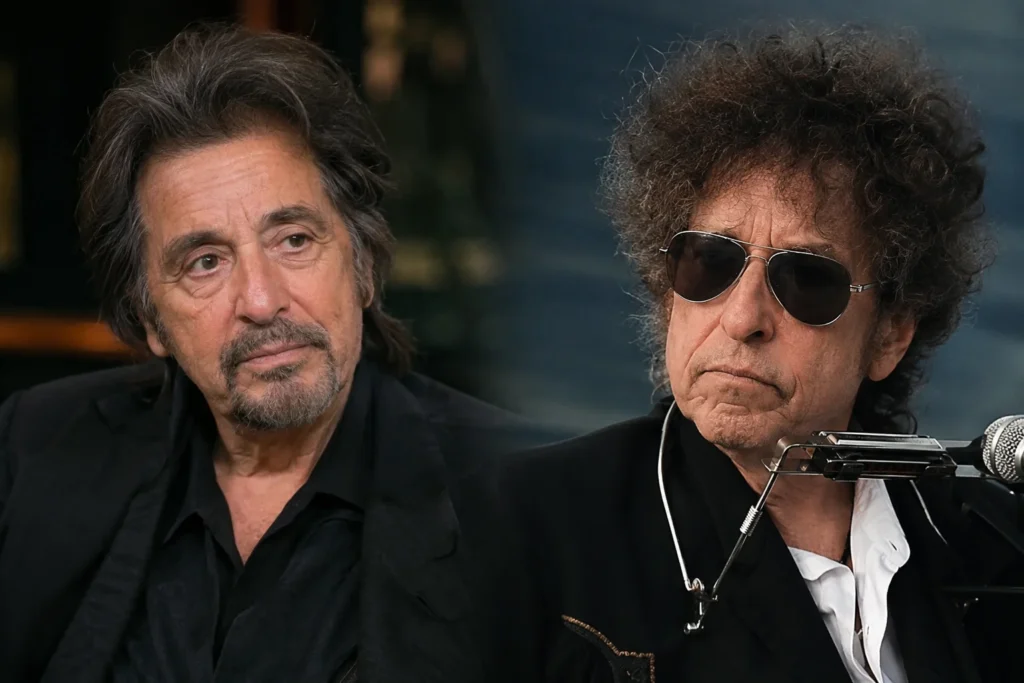
Al Pacino and Bob Dylan came from different corners of American art, but their careers crossed in a surprisingly natural way. Both emerged from New York’s creative culture, both built careers around highly personal forms of expression, and Pacino even spent time with Dylan in the 1970s. Years later, Dylan’s image became an important reference point for Pacino’s role in Danny Collins.
The connection isn’t that Pacino and Dylan worked together on a major film or record. They didn’t. It’s more interesting than that: two major artists came out of roughly the same cultural moment and occasionally occupied the same New York circles, while each developed a very different way of performing.
Al Pacino and Bob Dylan: What Connects Them?
The clearest documented connection is their shared history in New York and Pacino’s own recollections of Dylan.
In a 2015 interview about Danny Collins, Pacino said he knew Dylan and had spent time with him in the 1970s. Pacino joked that he couldn’t remember much about that period, but the statement confirms that their relationship was more than a simple celebrity comparison.
There is also a physical connection to Greenwich Village. Caffe Dante, a historic MacDougal Street café, lists both Al Pacino and Bob Dylan among the well-known figures who frequented the establishment. Forbes has also documented Dylan’s connection to the café and the surrounding Greenwich Village locations associated with his early career.
That matters because Greenwich Village wasn’t just a backdrop for Dylan. It was part of the artistic world that shaped him.
Pacino came out of a related New York theater culture. In a Village Voice interview, he discussed his early connection to the Village scene and The Living Theatre, describing that environment as an important source of inspiration.
Two artists, two different forms of performance
| Al Pacino | Bob Dylan |
|---|---|
| Primarily known for film, television and theater | Primarily known for songwriting and music |
| Broke through in the 1970s | Broke through in the early 1960s |
| Known for psychologically intense acting | Known for distinctive songwriting and performance |
| Won the Oscar for Scent of a Woman | Won the 2016 Nobel Prize in Literature |
| Built his reputation through characters | Built his reputation through songs and storytelling |
Pacino won the Academy Award for Best Actor for Scent of a Woman at the 1993 Oscars. Dylan received the 2016 Nobel Prize in Literature “for having created new poetic expressions within the great American song tradition.”
The difference is obvious, but there’s a useful similarity underneath it: neither artist became famous by simply presenting a polished, interchangeable version of himself.
Did Al Pacino Actually Know Bob Dylan?
Yes. Pacino himself said that he knew Dylan and had spent time with him during the 1970s. His recollection appeared while he was discussing Danny Collins in 2015.
There is a temptation to turn that into a dramatic Hollywood friendship story. The available evidence doesn’t support that.
What we can say with confidence is narrower and more interesting. Pacino and Dylan existed in overlapping New York cultural circles, and Pacino personally recalled spending time with Dylan. There isn’t strong evidence of a long-running professional partnership between the two.
That distinction is worth keeping. Celebrity stories often grow in the retelling.
Why Bob Dylan Matters to Danny Collins
The strongest artistic link between Pacino and Dylan came with the 2015 film Danny Collins.
Pacino plays an aging rock star who became famous as a young singer-songwriter but eventually stopped pursuing the kind of original writing that once made him promising. The character’s early reputation is repeatedly connected with the idea of being the “next Bob Dylan.”
Pacino explained that Dylan was one of the references being considered while he developed the character. He also mentioned Neil Diamond, Barry Manilow and Rod Stewart as other musical touchstones.
That tells us something important about the movie.
Danny Collins isn’t really an attempt to portray Bob Dylan. The character is fictional. Dylan is used as a cultural measuring stick: the young, serious songwriter whose talent suggests that something bigger might be possible.
That makes the comparison useful without making it literal.
Pacino’s character was built from several musicians
Pacino didn’t simply imitate Dylan’s voice, mannerisms or appearance.
In discussing the role, he described the character as a mixture of different musical personalities. The filmmakers also wanted Danny Collins to feel like his own performer rather than a direct copy of one real singer.
That’s one of the smartest aspects of the film’s concept.
Danny Collins represents a familiar entertainment-industry problem: an artist becomes successful enough to stop taking artistic risks.
Dylan represents almost the opposite idea. His career has been marked by repeated changes in sound, style and subject matter, from the folk recordings of the early 1960s through albums such as Bringing It All Back Home, Highway 61 Revisited, Blonde on Blonde and Blood on the Tracks.
What Makes the Dylan Comparison So Interesting?
Bob Dylan’s influence on popular culture goes far beyond his record sales.
He began performing in New York in 1961 and released his debut album, Bob Dylan, in 1962. His breakthrough period included The Freewheelin’ Bob Dylan in 1963 and a run of influential albums in the mid-1960s.
The Grammy Awards currently list Dylan with 10 wins and 38 nominations through the 2026 Grammy Awards.
Then came an honor that changed the conversation around him again.
In 2016, the Swedish Academy awarded Dylan the Nobel Prize in Literature. The Nobel committee specifically recognized the poetic qualities of his work within the American song tradition.
Pacino’s career followed a different route, but it also became associated with an unusually strong sense of artistic identity.
His performances in The Godfather, Serpico, Dog Day Afternoon and Scent of a Woman helped make him one of the defining American actors of his generation. The Academy records that Dog Day Afternoon received six Oscar nominations and one win in 1976, with Pacino nominated for Best Actor.
Their mediums were different, but both became reference points for younger performers.
The New York Connection Is the Part People Often Miss
When people search for the Al Pacino and Bob Dylan connection, they often focus on Danny Collins. That’s understandable, but it misses the deeper story.
New York was the common ground.
Dylan’s early career was closely tied to Greenwich Village. Pacino’s formative artistic experience was also tied to New York’s theater culture. Caffe Dante provides one particularly tangible meeting point because both men are documented as having been among its famous patrons.
This gives their connection a real-world texture that a simple “Pacino played a character inspired by Dylan” explanation doesn’t capture.
Imagine the cultural atmosphere of New York in the 1960s and 1970s: actors, musicians, writers and artists moving through the same neighborhoods, cafés and performance spaces. Careers were developing before Hollywood or the recording industry had completely defined them.
Pacino and Dylan were shaped by that kind of environment, even though they took very different roads afterward.
Al Pacino, Bob Dylan and the Question of Artistic Aging
There’s another reason the two names fit together so well.
Both careers raise questions about what happens after an artist becomes famous.
Danny Collins is specifically interested in an aging performer looking back at the person he might have become. Pacino described the character as a survivor who had found ways to remain successful after losing confidence in his own songwriting.
Dylan’s career offers a very different real-life example.
His work continued to change over decades, and the Nobel Prize recognized songwriting as a literary achievement rather than treating his music simply as popular entertainment. His 2016 Nobel banquet speech also showed how seriously he regarded the connection between songwriting, literature and storytelling.
That’s where the comparison becomes genuinely compelling.
Pacino’s Danny Collins asks what happens when an artist stops creating. Dylan’s career raises the opposite question: what happens when an artist keeps creating long enough to become part of cultural history?
That’s a much richer comparison than simply calling one person an influence on the other.
Al Pacino and Bob Dylan: Key Facts at a Glance
- Al Pacino is an American actor whose career spans film, television and theater.
- Bob Dylan is an American singer-songwriter, musician and writer.
- Pacino has said he knew Dylan and spent time with him in the 1970s.
- Both were associated with New York’s Greenwich Village cultural scene.
- Pacino played the fictional musician Danny Collins in the 2015 film Danny Collins.
- Dylan was one of the real musicians used as a reference point for the character.
- Pacino won the 1993 Academy Award for Best Actor for Scent of a Woman.
- Dylan received the 2016 Nobel Prize in Literature.
- Dylan has 10 Grammy wins and 38 nominations through the 2026 Grammy Awards, according to the Recording Academy.
What Can We Learn From Their Connection?
The most useful takeaway isn’t that Al Pacino was somehow part of Bob Dylan’s musical story. He wasn’t.
It’s that both artists came out of a New York culture where performance wasn’t neatly divided into categories. Acting, music, theater, poetry and literature could exist within the same creative conversation.
Pacino eventually became famous for disappearing into characters. Dylan became famous for making songs that could feel like short stories, poems or fragments of American history.
Their paths crossed personally, but the larger connection is cultural.
And Danny Collins made that connection visible to a much wider audience.
Read More About: Roger Federer and Conor McGregor: Two Very Different Paths to Sporting Fame
Frequently Asked Questions
Did Al Pacino and Bob Dylan know each other?
Yes. Al Pacino said in a 2015 interview that he knew Bob Dylan and had spent time with him in the 1970s. Pacino also had connections to New York’s Greenwich Village artistic community, where Dylan had established himself much earlier in his career.
Was Danny Collins based on Bob Dylan?
No. Danny Collins is a fictional story. Bob Dylan was one of the real musicians used as a reference when Al Pacino and the filmmakers developed the character, but Danny Collins wasn’t intended to be a direct portrayal of Dylan.
What movie did Al Pacino play a Bob Dylan-type character in?
Al Pacino played Danny Collins in the 2015 film Danny Collins. The character is an aging singer-songwriter whose younger self had been promoted as the next Bob Dylan. Pacino said Dylan was one of several musical references considered for the role.
Did Bob Dylan win a Nobel Prize?
Yes. Bob Dylan received the 2016 Nobel Prize in Literature. The Swedish Academy awarded the prize for his creation of “new poetic expressions within the great American song tradition.”
When did Al Pacino win his Oscar?
Al Pacino won the Academy Award for Best Actor at the 65th Academy Awards in 1993 for his performance as Lieutenant Colonel Frank Slade in Scent of a Woman. He had also been nominated for Best Supporting Actor that same year for Glengarry Glen Ross.
Conclusion
The story of Al Pacino and Bob Dylan is not a story about two celebrities who built a career together. It’s a story about proximity, influence and a shared New York artistic world.
Pacino knew Dylan in the 1970s, both men moved through overlapping Greenwich Village circles, and Dylan later became a clear reference point for Pacino’s fictional rock star in Danny Collins.
What I find most interesting is the contrast. Pacino became famous by inhabiting other people’s lives, while Dylan built his reputation by turning his own observations, characters and ideas into songs. Different crafts, different tools, but the same hunger to make something that people remember.
That’s probably why the two names continue to make sense together.