

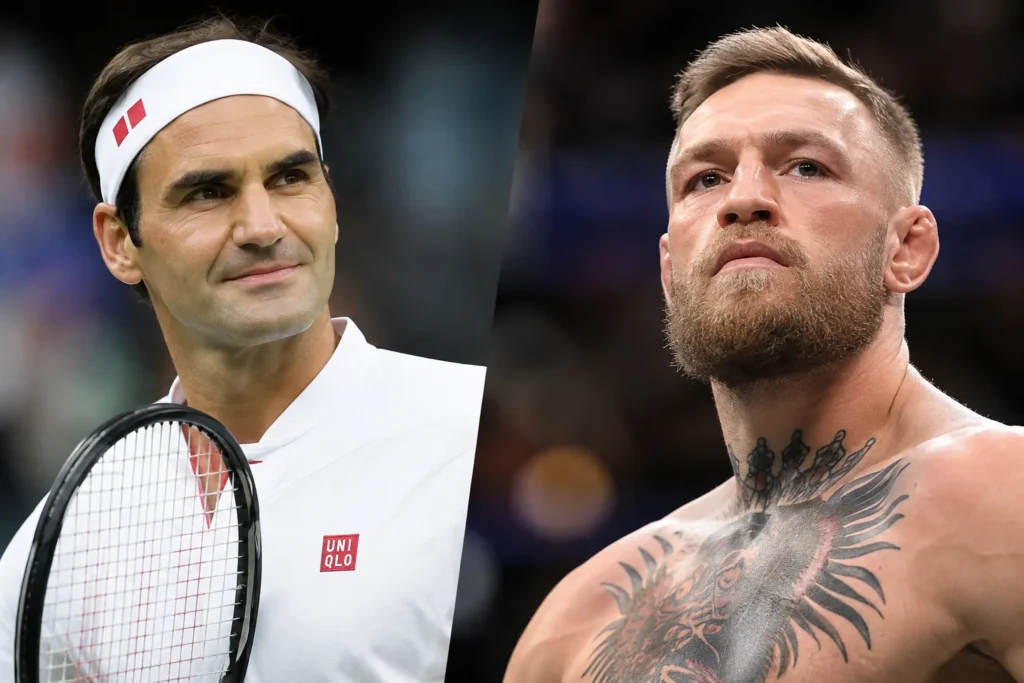
Roger Federer and Conor McGregor come from completely different sporting worlds. Federer built one of tennis’s greatest careers through consistency, technique and longevity, while McGregor became a UFC superstar through championship success, knockout power and an unusually strong ability to sell a fight.
They never competed against each other, and there is no well-established public record of a close friendship or business partnership between them. The interesting connection is what their careers reveal about modern sports fame: Federer became a global brand through sustained excellence, while McGregor turned personality and promotion into a major part of his sporting identity.
What connects Roger Federer and Conor McGregor?
The simplest answer is global sporting fame and commercial success.
Their achievements are not directly comparable because tennis and mixed martial arts use completely different competitive systems. Still, several useful comparisons stand out:
- Federer won 20 Grand Slam singles titles and 103 ATP singles titles.
- Federer spent 310 weeks as world No. 1, including a record 237 consecutive weeks.
- McGregor became the first UFC fighter to hold two division titles simultaneously in November 2016.
- McGregor’s UFC record is listed at 22-7-0, with 19 wins by knockout, according to UFC.
- Both athletes became major commercial figures outside their sports.
- Both have had close associations with luxury brands and high-profile sponsorships.
Federer’s career ended in 2022, while McGregor remains listed as an active UFC fighter in 2026.
Roger Federer: the tennis career that changed the standard
Federer’s professional career began in 1998. His first Grand Slam title came at Wimbledon in 2003.
He went on to win 20 men’s singles majors:
| Tournament | Federer titles |
|---|---|
| Australian Open | 6 |
| Roland-Garros | 1 |
| Wimbledon | 8 |
| US Open | 5 |
| Total | 20 |
His eight Wimbledon titles remain a tournament record in men’s singles. Federer also completed the career Grand Slam when he won Roland-Garros in 2009.
The numbers get more striking when you look beyond the majors. Federer finished with 103 singles titles and 1,251 singles victories, according to the ATP. He also spent 310 weeks at No. 1, with 237 of those weeks coming consecutively.
That longevity is one of the easiest parts of Federer’s career to overlook. Winning one major can be a career-defining achievement. Remaining among the world’s best for roughly two decades is something else entirely.
Federer after professional tennis
Federer announced his retirement in September 2022, with his final professional appearance coming at the Laver Cup in London.
His post-playing career has kept him closely connected to tennis. In August 2026, Federer was officially inducted into the International Tennis Hall of Fame alongside Mary Carillo.
He also remains closely linked with Rolex, a relationship that began in 2001. Rolex describes Federer as a global ambassador for the brand.
That matters because Federer’s public image has long extended beyond his match results. His appeal has been tied to tennis, fashion, watches, philanthropy and his reputation as one of the sport’s most recognizable figures.
Conor McGregor: from UFC contender to global celebrity
McGregor’s route was much shorter and far more explosive.
He made his UFC debut in April 2013. In December 2015, he defeated José Aldo by first-round knockout in just 13 seconds to become UFC featherweight champion. Less than a year later, he defeated Eddie Alvarez at UFC 205 and became the first fighter to simultaneously hold UFC titles in two weight classes.
That 2016 victory was a defining moment.
McGregor wasn’t simply winning fights. He was creating events around himself. His press conferences, interviews, clothing, trash talk and promotional style became part of the attraction.
UFC currently lists McGregor at 22 wins and seven losses, with 19 victories by knockout and one by submission. His UFC profile also records his 2026 return against Max Holloway, which ended with McGregor losing by TKO after an injury at 1:09 of the first round.
The commercial side of McGregor’s career
McGregor’s financial rise was remarkable even by elite-sport standards.
Forbes reported that he earned an estimated $180 million between May 2020 and May 2021, making him the highest-paid athlete on its 2021 list. A large part of that figure came from business activity outside his UFC fight earnings.
Federer reached the top of the same Forbes ranking a year earlier. Forbes reported $106.3 million in pre-tax earnings for 2020, with more than 94% coming from endorsements.
Those figures aren’t lifetime net-worth figures, and they shouldn’t be treated as an apples-to-apples measure of who was “richer.” They represent different reporting periods and different sources of income.
Still, they show something useful: neither athlete depended solely on sporting competition to build a global business identity.
Roger Federer vs. Conor McGregor: career comparison
A direct “who is better?” comparison doesn’t really work. Their sports measure success in different ways.
| Category | Roger Federer | Conor McGregor |
|---|---|---|
| Sport | Tennis | Mixed martial arts |
| Nationality | Swiss | Irish |
| Professional debut | 1998 | UFC debut in 2013 |
| Major achievement | 20 Grand Slam singles titles | First simultaneous two-division UFC champion |
| Major titles | 20 Grand Slams | UFC featherweight and lightweight titles |
| Career singles/MMA record | 1,251 wins, 103 titles | 22-7 professional MMA record |
| World No. 1 | 310 weeks | Not applicable |
| Wimbledon | 8 titles | Not applicable |
| UFC two-division champion | Not applicable | Yes |
| Professional retirement status | Retired in 2022 | UFC lists him as active in 2026 |
| Hall of Fame | International Tennis Hall of Fame, 2026 | No equivalent UFC Hall of Fame induction as of September 2026 |
Federer’s statistics come primarily from the ATP and ITF, while McGregor’s current record and UFC achievements come from UFC records.
What makes their careers so different?
The biggest difference isn’t personality. It’s the structure of their sports.
Tennis rewards a player for surviving an enormous number of matches across different surfaces and tournaments. Federer had to maintain his level across hard courts, grass and clay, often over many years.
MMA is different. A fighter can become a global star with a much smaller number of professional contests if the fights are significant enough.
That distinction helps explain the unusual shape of McGregor’s career. His total professional record is nowhere near the number of matches played by Federer, yet several of McGregor’s fights became major sporting events.
Federer’s achievement was sustained excellence.
McGregor’s was concentrated impact.
That’s a more useful comparison than simply counting trophies.
Their approach to personal branding
This is where the two athletes become surprisingly interesting together.
Federer’s brand has generally been built around refinement. His partnership with Rolex, long association with tennis’s biggest tournaments and carefully managed public image fit naturally with that identity. Rolex says its partnership with Federer began in 2001.
McGregor took almost the opposite route.
His personality was part of the product. He spoke loudly, dressed distinctively, promoted his fights aggressively and turned confidence into a central part of his public identity.
Neither approach is inherently necessary for sporting success. They simply demonstrate two different ways elite athletes can turn performance into recognition beyond the playing arena.
The money tells an interesting story
One small but revealing data point is the timing of their Forbes peaks.
- Federer: $106.3 million reported for 2020.
- McGregor: $180 million reported for 2021.
- Difference between those two reported annual figures: $73.7 million.
The figures come from different Forbes reporting periods, so they shouldn’t be treated as a direct financial competition. Still, the contrast shows how dramatically earnings can change when an athlete’s business interests, endorsements or major commercial transactions enter the picture.
There’s another interesting detail. Federer was the first tennis player to top Forbes’ highest-paid athlete ranking after the list began in 1990.
McGregor later became the first MMA fighter to occupy that No. 1 spot.
That’s a genuine point of connection between two athletes who otherwise followed very different paths.
Did Roger Federer and Conor McGregor ever compete?
No.
Federer competed professionally in tennis, while McGregor competed in mixed martial arts and also boxed Floyd Mayweather Jr. in 2017.
There has been no professional sporting contest between Federer and McGregor. Their names are generally grouped together because of their fame, commercial success and influence rather than because they shared a competitive rivalry.
That distinction matters. Search results and social media can make two famous names look more closely connected than the public record actually shows.
Are Roger Federer and Conor McGregor friends?
There is no strong public evidence establishing Federer and McGregor as close friends, business partners or regular sporting associates.
Their documented connection is better understood as one between two globally recognized athletes from different sports. Federer has spoken publicly about conduct in professional sport in contexts where McGregor’s behavior was mentioned, but that shouldn’t be stretched into evidence of a close personal relationship.
It’s a good example of why celebrity comparisons need a little caution. Two famous athletes appearing in the same headline doesn’t necessarily mean they have a meaningful relationship.
What can athletes learn from Federer and McGregor?
Their careers offer two very different lessons about building a lasting sports identity.
1. Performance comes first
Federer’s commercial appeal would have been very different without 20 Grand Slam titles.
McGregor’s promotional ability would not have carried the same weight without major UFC victories, including his wins over José Aldo and Eddie Alvarez.
2. A distinctive identity matters
Federer’s calm, polished image became part of his appeal.
McGregor’s outspoken persona became part of his.
Neither athlete looked like a generic version of another sports star.
3. Business can extend an athletic career
Federer’s relationship with Rolex and his wider commercial work continued after his retirement. McGregor built substantial business interests alongside his fighting career.
That is increasingly common among elite athletes, but these two provide particularly clear examples from different sports.
Where are Federer and McGregor now in 2026?
Their careers are at very different stages.
Roger Federer is retired from professional tennis and, following his August 2026 Hall of Fame induction, has moved firmly into the legacy stage of his career. He continues to appear at major tennis events and remains closely connected to the sport. He was also present around the 2026 Laver Cup in London, an event he helped create.
Conor McGregor returned to UFC competition in July 2026 after a lengthy absence. His fight with Max Holloway ended in an injury stoppage, and UFC’s current profile lists him as active.
So the two men now represent very different chapters of an athletic career: one is looking back on a completed tennis legacy, while the other remains part of professional combat sports.
Why people keep comparing them
The appeal of Roger Federer and Conor McGregor isn’t really about tennis versus MMA.
It’s about two athletes who understood that sporting fame can become much bigger than the competition itself.
Federer built his reputation slowly, with remarkable consistency over more than two decades. McGregor reached the highest levels of combat sports fame much faster and made promotion a central part of his career.
Their methods couldn’t be more different. That’s precisely why the comparison is worth making.
Federer showed how longevity can become a brand. McGregor showed how personality can become one.
Read More About: Muhammad Ali and Safra Catz: Is There a Connection?
FAQ
Are Roger Federer and Conor McGregor friends?
There is no well-established public evidence that Roger Federer and Conor McGregor are close friends. They come from different sports and have no competitive rivalry. Their connection is mainly based on their status as globally recognized athletes and their exceptional commercial success.
Has Roger Federer ever fought Conor McGregor?
No. Roger Federer and Conor McGregor have never competed professionally against each other. Federer spent his career in tennis, while McGregor competed in mixed martial arts and later professional boxing. Their sports require very different skills and competitive formats.
Who has more major titles, Roger Federer or Conor McGregor?
The numbers cannot be directly equated. Federer won 20 Grand Slam singles titles, including eight Wimbledon championships. McGregor became the UFC’s first simultaneous two-division champion in 2016. Each achievement belongs to a different competitive system.
Who earned more money, Federer or McGregor?
Forbes reported $106.3 million in earnings for Federer in 2020 and $180 million for McGregor in its 2021 highest-paid-athletes period. These are annual estimates from different reporting periods, not lifetime wealth figures.
Is Conor McGregor still fighting in 2026?
Yes. UFC currently lists McGregor as an active fighter. He returned in July 2026 against Max Holloway, losing by TKO after an injury ended the contest at 1:09 of the first round.
Conclusion
Roger Federer and Conor McGregor built their sporting identities in very different ways. Federer became famous through consistency, technical brilliance and more than two decades at the top of tennis. McGregor took a shorter, more explosive route, combining championship success with a personality that made his fights global events.
Their careers show that there isn’t one formula for becoming a major sports star. Federer turned longevity and performance into a lasting legacy, while McGregor turned competition, confidence and promotion into a powerful personal brand. Their stories are different, but both show how elite athletes can become influential figures far beyond their own sports.